Homily on the 7th Sunday after Pascha / Sunday of the Holy Fathers of the First Ecumenical Council
In the Name of the Father, and of the Son, and of the Holy Spirit.
We stand this morning between two great feasts. Behind us lies the holy Ascension of our Lord, celebrated only days ago; before us, the Pentecost, the Descent of the Holy Spirit, now only one week hence. We are suspended, as it were, between heaven and earth — watching with the disciples as the Lord has been taken up into the cloud, and waiting, as they waited, for the promise of the Comforter. It is a fitting moment for the Church to set before our eyes the holy God-bearing Fathers of the First Ecumenical Council, for it was precisely in such an interval — between the Ascension of Christ and the perpetual Pentecost of the Church’s ongoing life — that the Fathers at Nicaea were called to defend the very foundations of our faith.
The seventh Sunday after the Feast of Holy Pascha commemorates the 318 God-bearing Fathers who gathered in Nicaea in 325, at the request of the Emperor Saint Constantine the Great, to address the heresy of Arianism together with other matters that concerned the unity of the Church.
Who was Arius, and what did he teach? He was a priest of the Church of Alexandria who, beginning around 315, blasphemed against the Son of God, teaching that He was not the true God consubstantial with the Father, but rather a creation of God, different in essence and glory from the Father, and that the Son of God had a beginning.
Let t us pause and feel the weight of what is being said here. Arius was not a pagan. He was not a persecutor. He was a clergyman of the Church, educated, eloquent, and persuasive — and he was teaching that Jesus Christ is not God. Not God in the fullest sense. Not the God, equal to the Father, of one essence with the Father. He was teaching that when we pray to Christ, we pray to a creature — exalted, yes, the highest of creatures, but a creature nonetheless. He was teaching that the Incarnation was not God Himself taking flesh, but a demigod, a lesser divine being, entering the world.
Arius was a man of great pride and ambition. And it is pride that lies at the root of all heresy. The heretic does not submit his mind to the Revelation of God; he submits the Revelation of God to his mind. He says: “This teaching does not make sense to me, therefore it cannot be true.” And Arius said precisely this: it does not make sense to me that God could have a Son who is equal to Himself; it does not make sense to me that the One God could also be Three. And so he rationalized, and trimmed, and cut the faith down to the size of his own understanding — and in so doing, destroyed it entirely.
The Church has appointed as today’s Gospel the seventeenth chapter of Saint John — the prayer which our Lord Jesus Christ offered to His Father on the night of His betrayal, before He went to the Garden of Gethsemane. It is called by the holy Fathers the High-Priestly Prayer, for in it Christ prays as our great High Priest, interceding for His disciples, for the Church, for all who would believe through the Apostles’ witness, and indeed for the whole world.
Why is this Gospel appointed for the Sunday of the Fathers? Because it is the very text that proves Arius wrong. Listen to the words of Christ Himself:
“And now, O Father, glorify Thou Me with Thine Own Self with the glory which I had with Thee before the world was” (St. John 17:5).
Before the world was. Before creation. Before time itself. The Son had glory with the Father — not a created glory, not a borrowed glory, but His own glory, shared with the Father from before all ages. Here Christ asserts His own eternal pre-existence in the most unambiguous terms. There was no moment when He was not; there was no time before His generation from the Father. He is not a creature. He is the eternal Son, co-eternal and consubstantial with the Father.
And again:
“That they all may be one; as Thou, Father, art in Me, and I in Thee” (St. John 17:21).
The unity of the Father and the Son is not a unity of will merely, as the Arians claimed — as if the Son simply agreed with the Father in all things. It is a unity of essence, of nature, of being. The Fathers gathered at Nicaea saw this clearly, and they gave it a name: ὁμοούσιος — consubstantial, of one essence.
At the Council, the Fathers set forth and confirmed the Apostolic teachings about Christ’s divine nature. The heresy of Arius was exposed and repudiated as an error of haughty reason. And in its place, the Fathers gave us the Symbol of Faith — the Nicene Creed — which we chant at every Divine Liturgy.
The Creed, which begins with the words “I believe in one God the Father, Almighty, Maker of heaven and earth, and of all things visible and invisible,” briefly outlines the essence of the Orthodox faith. In order to denounce the Arian heresy about the Lord Jesus Christ, it declares that He was begotten of God the Father, and not created. At the Second Ecumenical Council this Creed was supplemented with the teaching about the One Holy Catholic and Apostolic Church, about Baptism, and the Resurrection.
The Creed remains in this form to this day. Every Sunday, every liturgy, we stand and confess it together. Let us not do so thoughtlessly, brethren. When you say “I believe in one Lord Jesus Christ, the Son of God, the Only-begotten, begotten of the Father before all ages, Light of Light, True God of True God, begotten not made, of one essence with the Father” — know that these words were written in the blood of confessors. Know that bishops came to Nicaea bearing the marks of the persecutors’ torture. Know that the Church fought for every syllable of that Creed, and that her enemies, then as now, never tire of trying to tear it down.
The troparion of the feast :
“Thou art most glorious, O Christ our God! Thou hast established the Holy Fathers as lights on the earth! Through them Thou hast guided us to the true faith! O greatly Compassionate One, glory to Thee!”
The Church venerates the Holy Fathers of the Ecumenical Councils because Christ has established them as lights upon the earth, guiding us to the true Faith. Adorned with the robe of truth, the doctrine of the Fathers, based upon the preaching of the Apostles, has established one faith for the Church.
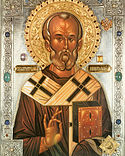
Among those 318 who assembled at Nicaea were men we know and venerate by name. Saint Nicholas of Myra was there — the same wonder-worker whose relics rest in Bari and whose memory we celebrate twice yearly. Saint Spyridon of Trimythous was there — the simple shepherd-bishop who confounded the philosophers with a piece of clay, demonstrating the mystery of the Trinity. Saint Alexander of Alexandria was there, who had first stood against Arius and suffered for it. And Saint Athanasius — not yet a bishop, but already a deacon of great theological perception — attended as secretary to his bishop, and would spend the rest of his long life defending the Nicene faith against wave upon wave of imperial and episcopal pressure. Athanasius contra mundum — Athanasius against the world. The world was Arian for a time. But the truth of Nicaea prevailed.
This is the promise of Christ: “I will build My Church, and the gates of hell shall not prevail against it” (St. Matt. 16:18). Although the Church of Christ on earth will pass through difficult struggles with the Enemy of salvation, she will emerge victorious. The holy martyrs bore witness to the truth of the Savior’s words, enduring suffering and death for confessing Christ, but the persecutor’s sword is shattered by the Cross of Christ. And the heretic’s sophistries are shattered by the Creed of the Fathers.
Beloved, let no one suppose that the Council of Nicaea is merely a matter of ancient history with no bearing on our lives today. It would seem that the First Ecumenical Council and the teachings of Arius are matters of the days long gone, and they cannot have anything to do with us. Yet every Sunday we confess the Creed precisely because the temptation to diminish Christ, to make Him less than He is, never ceases.
Arianism lives wherever Christ is spoken of as a great teacher, a moral example, an enlightened sage — but not as the eternal Son of God, not as True God of True God. Arianism lives in the theology of the Jehovah’s Witnesses, who deny the full divinity of Christ almost word for word as Arius did. Arianism lives wherever the humanity of Christ is acknowledged but His divinity is quietly set aside — in the seminaries of the West, in the pulpits of liberal Protestantism, and in the hearts of the lukewarm baptized who have never been taught what they actually professed at the font.
The Fathers of Nicaea did not fight for an abstraction. They fought because the divinity of Christ is the foundation of our salvation. If Christ is not truly God, then His death on the Cross does not redeem us — for only God can forgive sins, and only a divine sacrifice is of infinite worth. If Christ is not truly God, then His Resurrection does not deify us — for only He who is God by nature can make us partakers of the divine nature. The whole economy of salvation stands or falls on the truth that the Nicene Fathers confessed: that Jesus Christ is True God of True God.
Brethren, let us depart this feast with a renewed reverence for the Symbol of Faith. The next time we stand and chant the Creed at the Divine Liturgy, let us hear it not as a formality but as a battle-cry — the battle-cry of 318 God-bearing Fathers, of Athanasius the Great, of Nicholas the Wonder-worker, of all the holy confessors who suffered that we might have the truth.
Let us also examine ourselves. Do we truly believe what we confess? Do we live as those who worship the True God — Father, Son, and Holy Spirit — one in essence and undivided? Do we treat prayer with the seriousness it deserves, knowing that we speak not to a prophet or a sage but to the Creator of the universe, Who took flesh and dwelt among us?
The Lord prayed for us in His High-Priestly Prayer: “Holy Father, keep through Thine own Name those whom Thou hast given Me, that they may be one, as We are” (St. John 17:11). He prayed for our unity — our unity with one another in the true faith, and our unity with Him in the Holy Spirit. Let us not waste that prayer by indifference, by worldliness, by compromise with the heresies of our age.
Let us rather stand firm in the faith of the Fathers, as the kontakion declares: “The Apostles’ preaching and the Fathers’ doctrines have established one faith for the Church. Adorned with the robe of truth, woven from heavenly theology, it defines and glorifies the great mystery of Orthodoxy.”
To the Holy, Consubstantial, Life-creating, and Undivided Trinity be all glory, honour, and worship: to the Father, and to the Son, and to the Holy Spirit, now and ever, and unto the ages of ages. Amen.
Glory to Jesus Christ! — Glory for ever!